
Language learning · 13 min read
How to Learn a Language by Reading Books
Reading books can be one of the most useful ways to improve a language.
But there is a catch:
You need to spend most of your time reading the book, not searching dictionaries.
A practical way to learn through books is:
Choose a book you mostly understand. Read for meaning. Skip unknown words that do not matter. Check the words that block your understanding. Then continue reading.
You do not need to understand every word.
You need to understand enough to keep turning pages.
Research on extensive reading supports the basic idea behind this approach: reading large amounts of relatively understandable material can improve vocabulary, reading comprehension, fluency and other areas of second-language learning. (Sangers et al., 2025)
This guide turns that research into a method you can use with a real book.
Does learning a language by reading books actually work?
Yes — but reading should not be your only language-learning activity.
A 2025 meta-analysis of extensive reading in second- and foreign-language learning found positive effects across all the language domains it examined, including vocabulary, reading comprehension, decoding and fluency, motivation, writing, oral proficiency and general language proficiency. The effects ranged from small to medium. (Sangers et al., 2025)
Research also shows that learners can acquire some vocabulary incidentally while focusing on meaning rather than deliberately memorizing every word. A 2023 meta-analysis covering meaning-focused second-language input found significant incidental vocabulary learning, although the amount learned varied substantially. (Webb, Uchihara & Yanagisawa, 2023)
That does not mean:
“Read novels and you will automatically become fluent.”
Speaking requires speaking practice.
Listening requires experience with spoken language.
But books can give you something extremely valuable:
a large amount of vocabulary and sentence structure inside meaningful context.
1. Choose a book you mostly understand
The hardest book you can survive is usually not the best book for learning.
If nearly every sentence contains several unknown words, most of your attention goes into decoding the text.
The story becomes harder to follow.
Reading becomes slow.
And quitting becomes much more tempting.
Researchers often describe this difficulty using lexical coverage — the percentage of running words in a text that a reader already knows.
Figures around 95% and 98% coverage are frequently discussed in second-language reading research.
But they should not be treated as magical pass-or-fail numbers.
The reader, the subject, the writing style and the ability to infer meaning from context also matter.
Recent research comparing texts at 90%, 95% and 98% lexical coverage found that learners' ability to infer unfamiliar words was lower at 90% than at 95% or 98%. (Pellicer-Sánchez et al., 2024)
A simple 100-word check
You can turn lexical coverage into a rough practical check.
Open a random page and look at about 100 running words.
If approximately 2 words are unknown, that is roughly 98% known-word coverage.
If approximately 5 words are unknown, that is roughly 95%.
If considerably more than five words out of every hundred are unfamiliar, expect more frequent interruptions.
This is not a scientifically validated test. It is simply an easy way to translate lexical coverage into something you can estimate while holding a book.
The more important question is:
Can you follow what is happening without stopping every few sentences?
If yes, the book may be a good choice.
If no, something easier will probably give you a better reading experience.
How many words do you need to read a book in another language?
2. Read most of the book extensively
There are two useful ways to read while learning a language.
Extensive reading
You read mainly for the story, information or enjoyment.
You keep moving.
You accept that some things will remain unclear.
You do not analyze every sentence.
This is the kind of large-scale, meaning-focused reading supported by extensive-reading research. (Sangers et al., 2025)
Intensive reading
Sometimes you deliberately slow down.
Maybe a sentence contains an expression you want to understand.
Maybe you keep noticing the same grammatical structure.
Maybe a paragraph is important but difficult.
Then studying it carefully makes sense.
You do not have to choose one approach.
A useful practical combination is:
Read most pages extensively. Study a few interesting passages intensively.
That gives you both volume and deliberate learning.
3. Don't look up every unknown word
Imagine you read:
Beyond the gate stood a dilapidated cottage.
You do not know dilapidated.
But you still understand that there is a cottage beyond the gate.
If the exact condition of the cottage does not matter, keep reading.
Now compare:
The jury acquitted him.
If you do not understand acquitted, you may completely misunderstand what happened.
That word matters.
So when you encounter an unfamiliar word, ask:
Do I need this word to understand what is happening?
If no:
Skip it.
If yes:
Check it.
Then:
Continue reading.
Skip → Check → Continue
That is the basic method used in this guide.
It is a practical rule, not the name of an established scientific technique.
You can also check a word when it keeps appearing or when you simply want to know it.
The important idea is that:
unknown does not automatically mean important.
4. Ask what the word means here
Consider the word charge:
The hotel charged us €30.
The bull charged toward him.
The police charged him with theft.
The word is the same.
Its meaning is not.
A dictionary can tell you everything charge might mean.
But while reading, your real question is:
What does this word mean here?
Context therefore matters.
Research on lexical coverage and inferencing shows that readers use surrounding information when trying to infer unfamiliar vocabulary — and that successful inference becomes harder when too much of the surrounding text is unknown. (Pellicer-Sánchez et al., 2024)
So try this:
Read the sentence first. Make a quick guess. Then verify it.
You do not need to spend thirty seconds solving every word.
Just give the context a chance before looking at the answer.
5. Make necessary lookups as short as possible
Unknown vocabulary is only half of the problem.
The other half is interruption.
A traditional lookup can become:
Book → unknown word → leave the book → open dictionary → type word → inspect definitions → return to book → find the sentence again
Once is nothing.
Twenty times in one chapter is different.
The ideal lookup is:
Unknown word → understand it → continue reading.
That is the problem ClickBook was built around.
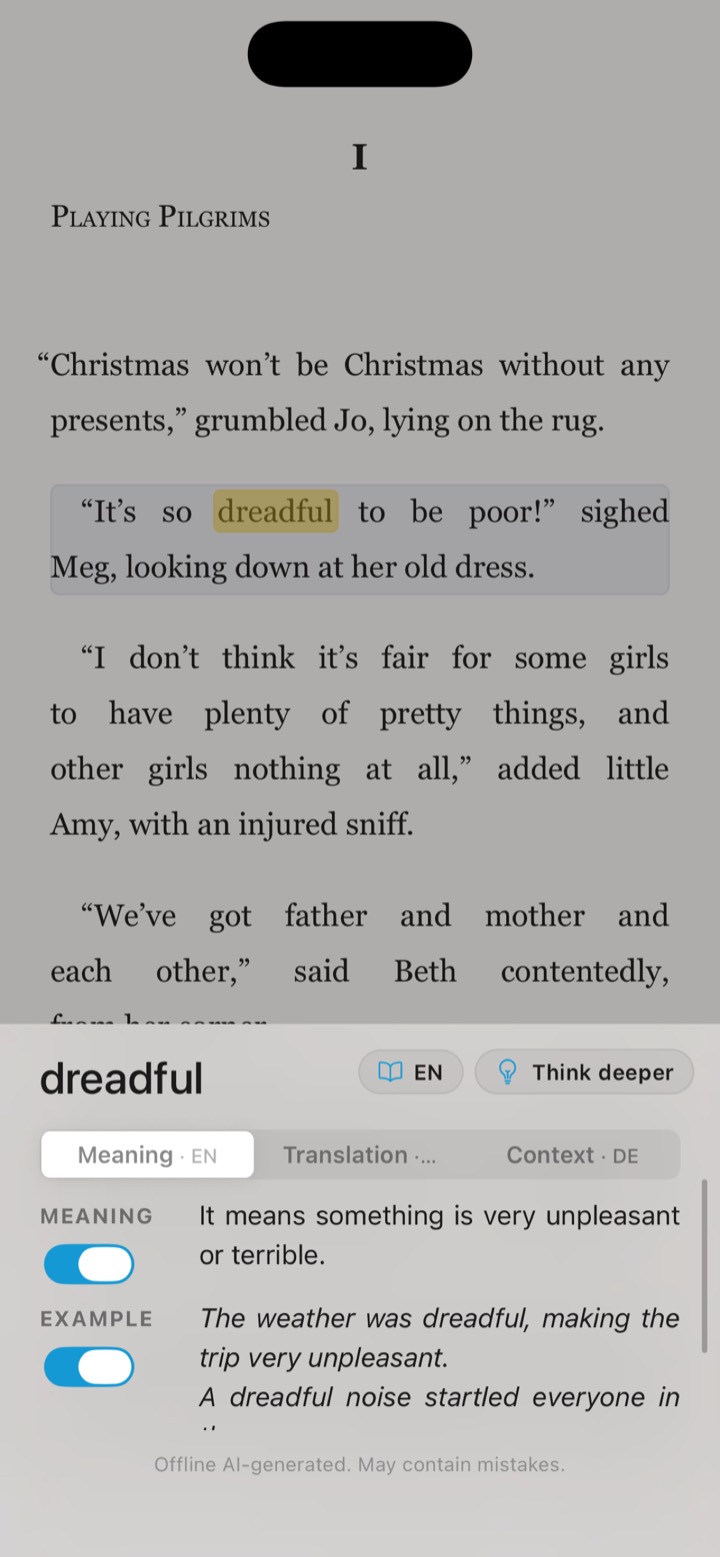
Import an EPUB or readable PDF and read normally.
When an unfamiliar word gets in the way, tap it.
ClickBook uses the surrounding sentence and its on-device AI to give you the relevant meaning, a translation and an example in your chosen mother tongue.
So instead of:
Book → dictionary → translator → book
you get:
Book → tap → understand → keep reading.
Try ClickBook with your own book →
6. Let the book show you words more than once
You probably will not completely learn a new word after seeing it once.
Suppose you encounter:
She was reluctant to answer.
You check reluctant and continue.
Later:
He reluctantly followed them.
And later:
His reluctance was obvious.
Now you have seen the same idea in several contexts and forms.
Research supports a relationship between repeated encounters and incidental second-language vocabulary learning, although repetition is only one of several factors affecting whether a word is remembered. (Uchihara, Webb & Yanagisawa, 2019)
This is one reason books are useful.
Vocabulary, topics, expressions and grammatical patterns naturally reappear across a long text.
Some unfamiliar words will disappear forever.
Important ones often return.
You do not need to force every unknown word into long-term memory the first time you meet it.
Sometimes the book gives you another chance.
7. Study vocabulary selectively
Flashcards and vocabulary lists can be useful.
But turning every unfamiliar word into homework creates another problem:
You start spending more time managing vocabulary than reading.
Instead, deliberately study words that:
- keep appearing
- seem useful outside the book
- matter to a subject you care about, or
- are words you personally want to use.
Other words can remain passive vocabulary.
You do not need to actively produce every word you can understand.
8. Don't translate every sentence automatically
Translation is useful support.
But it does not need to become the main activity.
Try this order:
- Read the original sentence.
- Use the surrounding context.
- Check the difficult word if necessary.
- Read the original sentence again.
- Use a fuller translation only if the meaning is still unclear.
The goal is gradually to understand more directly from the language you are learning.
Translation can help you get there without replacing the original text.
9. Pick books you actually want to finish
Difficulty is only one part of choosing a book.
Interest matters too.
You may happily tolerate a slightly difficult mystery because you desperately want to know what happens next.
Meanwhile, the “perfect beginner book” may stay untouched because it bores you.
Good starting points can include:
- graded readers
- shorter novels
- books you already know in another language
- dialogue-heavy fiction
- mysteries and thrillers
- short stories, and
- nonfiction about subjects you already understand.
Do not automatically assume children's books are easy.
Some contain rare vocabulary, wordplay, invented words or old-fashioned language.
Judge the actual text, not only the age written on the cover.
Find something at your level
ClickBook's English library currently contains 170 free public-domain books, all available as EPUBs.
Difficulty is calculated from each book's actual text using CEFR-graded vocabulary data, and the shelf can be filtered by level, length and genre.
Browse 170 free English books by difficulty →
10. Try this 30-minute reading routine
You do not need a complicated study plan.
Here is one simple routine:
First 20 minutes: Read
Follow the story or subject.
Use:
Skip → Check → Continue
Keep moving whenever you understand enough.
Next 5 minutes: Investigate
Choose two or three useful things you noticed.
Maybe:
- a word that appeared several times
- an interesting expression, or
- a sentence structure you want to understand.
Look at those more carefully.
Final 5 minutes: Reread
Go back one or two pages.
Read them again with as few interruptions as possible.
Then stop.
Continue tomorrow.
The 30-minute split is a practical routine suggested by this guide, not a duration prescribed by research.
Change it to fit your schedule.
The important part is to spend meaningful time reading.
What if you're a beginner?
You do not need to wait until you are “good enough” to read.
You need appropriate material.
Start with graded readers, short simple texts, familiar stories or other supported reading material.
Increase the difficulty gradually as comprehension improves.
Your first goal is not to prove that you can survive a difficult novel.
It is to find material that allows you to keep reading.
Can you learn a language only by reading books?
Not completely.
Reading can contribute to vocabulary, comprehension, fluency and wider second-language development. (Sangers et al., 2025)
But reading does not reproduce the experience of listening to fast spontaneous speech or producing sentences during a real conversation.
If broad proficiency is your goal, combine reading with listening and speaking.
Think of books as one powerful part of a larger system.
Their biggest advantage is that you can spend a long time interacting with real language while paying attention to something more interesting than the language itself:
the book.
So what is the best way to learn a language by reading books?
Use this method:
Choose a book you mostly understand.
Read primarily for meaning.
Read most pages extensively.
Slow down occasionally when something is worth studying.
Skip words that do not block understanding.
Check words that do.
Use the surrounding sentence to find the relevant meaning.
Let repeated encounters reinforce vocabulary.
Keep reading.
The goal is not perfect comprehension.
The goal is enough comprehension to keep moving through real language.
Make the difficult words the easy part
ClickBook is an EPUB and readable-PDF reader designed around this exact problem.
Import your own book and read normally.
When an unfamiliar word gets in the way, tap it.
ClickBook uses the surrounding sentence and on-device AI to generate a meaning, translation and example in your mother tongue. More than 40 mother-tongue languages are currently supported.
Its AI runs locally on the device. Once the model is in place, reading and word lookups can work without an internet connection. ClickBook requires no user account and says it contains no advertising SDKs or third-party analytics.
You do not need AI to read the book for you.
You need help for the few seconds when you cannot understand the book.
Then you want to keep reading.
Tap a word. Understand it. Keep reading.
-

-
 Coming soon
Available on iPhone, iPad and Android.
Find a free book at your level
Frequently Asked Questions
Is reading books a good way to learn a language?
Yes. A recent meta-analysis of extensive reading research found positive effects across vocabulary, reading comprehension, fluency and several other areas of second- and foreign-language learning. (Sangers et al., 2025)
Should I look up every word while reading?
Usually not. A practical approach is to check words that prevent you from understanding an important sentence, keep appearing or are particularly useful to you. If you can still follow what is happening, continue reading.
How much of a book should I understand?
There is no single percentage that guarantees comprehension. Lexical coverage around 95–98% is frequently discussed in second-language reading research, while lower coverage generally makes successful inference harder. (Pellicer-Sánchez et al., 2024)
Is 95% vocabulary coverage enough?
It can be enough to read with support, but it means roughly five unknown running words per hundred. At 98%, that falls to roughly two. Treat those figures as reference points rather than universal thresholds.
Can you learn vocabulary just by reading?
Some vocabulary can be acquired incidentally through meaning-focused exposure. A 2023 meta-analysis found significant incidental L2 vocabulary learning, although gains varied substantially between studies and conditions. (Webb, Uchihara & Yanagisawa, 2023)
Does seeing the same word repeatedly help?
Repeated encounters are associated with incidental vocabulary learning, although repetition alone does not guarantee that a word will be fully learned. (Uchihara, Webb & Yanagisawa, 2019)
Should beginners read real books?
Beginners can read, but appropriately simplified material such as graded readers will usually be easier to use than a difficult authentic novel.
Can ClickBook work offline?
Yes. Once its on-device AI model is in place, ClickBook says reading and word lookups work without an internet connection.
Research used in this article
- Sangers, N. L., et al. (2025). Learning a Language Through Reading: A Meta-analysis of Studies on the Effects of Extensive Reading on Second and Foreign Language Learning. Educational Psychology Review. DOI: 10.1007/s10648-025-10068-6 https://doi.org/10.1007/s10648-025-10068-6
- Webb, S., Uchihara, T. & Yanagisawa, A. (2023). How effective is second language incidental vocabulary learning? A meta-analysis. Language Teaching, 56(2), 161–180. DOI: 10.1017/S0261444822000507 https://doi.org/10.1017/S0261444822000507
- Uchihara, T., Webb, S. & Yanagisawa, A. (2019). The Effects of Repetition on Incidental Vocabulary Learning: A Meta-Analysis of Correlational Studies. Language Learning, 69(3), 559–599. DOI: 10.1111/lang.12343 https://doi.org/10.1111/lang.12343
- Pellicer-Sánchez, A., et al. (2024). How does lexical coverage affect the processing of L2 texts? Applied Linguistics, 45(6), 953–978. https://academic.oup.com/applij/article/45/6/953/7841943